A Medical Adventure in Spain
Team physician at the 2000 Mountain Bike World Championships: a downhiller’s infected knee, a septic Aussie at 3 a.m., and a throne at the bottom of the mountain.
A bonus adventure story that didn’t make it into Adventures in Medicine and Redemption in Hospice.
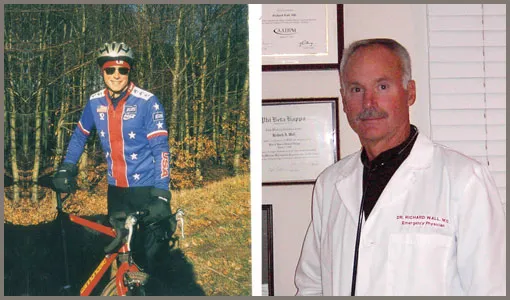
“Doc, do ya think I can race the downhill in four days?… it may be my last chance to win the world championship,” the gnarly mountainbiker asked as he limped into my makeshift medical clinic and plopped down on my examination and operating table, a rickety single bed in a Spartan hotel room in Sierra Nevada, Spain where The 2000 World Mountainbike Championship was being held. Through my connections with USA Cycling and being a volunteer physician at the Olympic Training Center while having been a competitor myself in World Championship in past appearances as a member of the USA Masters Mountainbike Team, I had been selected as the team physician for the USA Moutainbike Team. Ready for business, I had just arrived to the mountainous ski area above Grenada and had just finished setting up my mini MASH unit with medical supplies from my golf traveling case sans golf clubs.
Giving him what I called my ER five second visual biopsy, my initial medical intuition was to get a sense of what and where his problem was, how bad was it, potential prognosis, and not so much about his character, but what kind of character he was. My response to his question was, “let’s take a look” although glancing at his swollen, red, inflamed knee, twice the size of his normal one, his competing was doubtful. He certainly looked the part of being an aging professional downhiller with long scraggly hair, a lined, rugged face, beefy muscular build, and grungy clothes. Nevertheless, despite his obvious pain, he had a warm, cocky smile exuding the laidback friendliness of a Western Slope Colorado mountainbiker who he was. Being a cross country mountainbike racer, I never had the nerve, skill, or death wish to downhill race. My family and friends thought I was pretty crazy to do what I did considering how rough and technical most of the cross country courses had become, often crashing and usually having a few healing dings on my body. But, the downhillers were a different breed, dressed more like gladiators than cyclists, they rode their mountainbikes over and through obstacles, drop-offs, and radical terrain that required as much skill as madness. Although our competitive careers had never crossed, his being a pro downhiller and my being a cross country amateur, I recognized his name as he had been one of the top male USA downhillers for several years.
Before I “laid hands on,” I asked him about the past and recent injuries he’s had. He chuckled, “too many to count, doc, tore it up bad several times. The last one was a year ago in Slovenia when I crashed and had a big dirty cut over my knee cap. I went to a crummy medical clinic where a nasty, grumpy doc cleaned it out without numbing it up and just stitched me up. It healed up ok, but over the past week it started getting red and swollen under the scar. Now, it hurts to bend my knee, and it looks like I got a big pimple in there about ready to burst.”
Actually, I thought that was a good history, and it addressed a lot of my concerns about the seriousness of the problem. First, I took his pulse, blood pressure, and temperature, vital sign clues to whether the suspected infection had extended into him systemically. His pulse was normal, not fast. His blood pressure was normal, not low. His temperature was normal, not high. They were all good signs that the infection had not affected him beyond his knee into his general circulation.
Next, I asked him to lay back on the bed to take a good look at his knee. I pulled up the lower edge of his droopy shorts to fully expose his knee and upper leg. I noted that there was around a 4 inch diameter of raised red swelling, erythema, over his knee cap, patella, with a tented 3 inch scar running across it. It looked like the swelling and redness was confined to the front of the kneecap, prepatellar, without evidence of its extension into the joint space behind it indicating fluid, an effusion, inside the joint, which would be an ominous finding. Nor, did he have evidence of “blood poisoning,” lymphangitis, with streaks of redness extending up his leg from his knee. If he had indications of either of these complications, my next step would have been to contact a hospital in Grenada to ready transport as soon as possible. Fortunately, he didn’t, so I proceeded with the exam to verify my initial assessment that the infection was localized outside the joint and was not extending into the rest of his body.
I put on exam gloves and lightly palpated his knee starting to the sides and back first, not wanting to influence my exam by stirring up the actual problem. He had no real discomfort doing that until I palpated the anterior of the knee which felt soft and doughy, fluctuant, indicating that there was most likely a collection of pus inside his giant pimple being an abscess. Just to confirm my judgment, I did a limited exam of his knee’s range of motion and stability of its ligaments. His range of motion was slightly limited on knee flexion due to the abscess’s overlying skin being stretched. However, if he had a real infected joint effusion, he wouldn’t have allowed me to barely bend it. What did surprise me was the laxity of his knee ligaments from all his crashes when I checked them making me wonder how he competed at all. But, that wasn’t the problem today although I feared it would become major issues for him a few years down the line.
My conclusion was much more optimistic than when I first saw him hobble into my clinic. It looked like he had an abscess outside the knee joint above the patella with no signs of systemic involvement probably from some retained small foreign body from his accident a year ago. It would require me to do an incision and drainage to drain the pus out. Whatever foreign body was still in there had to be small not to cause any problems for over a year, and I wondered whether I could identify it if it flowed out with the pus. Even so, he wasn’t out of the woods yet in being able to compete, especially at full capacity.
I explained it all to him, and he readily agreed to go under the knife. Fortunately, I had brought a few disposable suture sets with instruments, drapes, syringes, and lidocaine. I also had disposable scalpels. I cleansed and gently prepped his knee with betadine. And as I had done so many times in the ER when a nurse wasn’t available to assist, I used as much sterile technique as possible to open the suture kit, plop the knife blade on it, and put on my sterile gloves. Then, I draped his knee, drew up the lidocaine, and injected his knee over where I planned to make my incision. I gave it a few minutes to anesthetize the area as best I could considering that it is difficult at times to do with a large abscess when they need to be probed. I made the incision, and as with most abscess’s needing draining, the stinky, yellowish pus poured out under pressure spilling out over the drapes. Fortunately, for me, as sometimes happens, the pus didn’t squirt out landing on me. The incision was extending wide enough that I could open up the abscess to irrigate out any retained pus as well for me to peek inside for a foreign body. Sure enough, a tied black silk suture, no longer tied to anything, caught my attention, and I removed with my hemostat.
I left the wound open, squirted antibiotic ointment in it, and dressed it loosely. I didn’t tell him my concerns about how the wound was originally handled as I was not there. I probably wouldn’t have put in an interior suture, especially a non dissolvable silk suture, in a contaminated dirty wound. Fortunately, the wound didn’t get infected initially because of it, but most likely his body eventually identified the silk suture as a foreign body, thus, the delayed inflammatory response a year later. I might not even have put any sutures exteriorly if it was really dirty leaving it open to allow drainage, letting the wound heal by secondary intent from the bottom to top, not caring about scarring. In any case, that was how I was planning to manage him, now. I made it clear that he was not to practice, and he needed to keep his leg elevated. He was to have daily wound checks and dressing changes with me. I would decide when he could practice or compete. I gave him antibiotics from my supplies to take as well. He left thankful and optimistic with a firm handshake and good ol’ boy smile. I sighed with relief that the situation was manageable, glad that he had a better chance to race than I originally assumed.
I saw a couple of other cyclists after that, nothing serious, mainly questions about chronic injuries, medications, and physical preparation for competing. One got a B12 shot in a hardened butt that had had too many. Maybe not so necessary, but part of her major pre race routine affecting her confidence. Another pro cross country racer wanted to have a pre race liter of IV fluid as he was concerned about his ability to hydrate enough during the expected hot, dry race.
My wife and I had dinner with the team, and I was introduced to them. We sat with several of them and had surprisingly deep discussions. Their cocky exterior seemed to dissolve. Despite being at the top of their racing profession, many of them seemed emotionally vulnerable, deeply concerned about their performance and sponsorship which was tied to the continued ability to compete. Like all professions they had their worries, too, especially considering how fleeting, injury prone, and financially insecure theirs were.
About three am the next morning I was awakened by my room phone ringing. Still half asleep, I had difficulty understanding the anxious caller with a strong Australian accent. After asking him to repeat what he said more slowly, I learned that he was the head coach for the Australian Mountainbike Team, which was staying in the same hotel a floor above us. Their team did not have a physician with them, and he knew the USA Team did have one. He asked if I would come see one of his junior downhillers who was having a “seizure” as he was jerking, but awake and talking. It didn’t sound like a grand mal seizure which was reassuring, but it sounded serious. I quickly got dressed and rushed upstairs.
I was met at the top of the stairs by the frazzled coach who escorted me quickly down the hallway to the downhiller’s room. Walking into the room, there were four occupied beds with young, barely awake, tough looking Aussie kids. It wasn’t difficult to pick out the one who was having the “seizure” as he lay clutching a blanket to his neck, his exposed hands shaking on top of it, and his body writhing underneath it. His distressed eyes were widely open below his taunt forehead which was beaded with sweat forming rivulets at his temples soaking his hair and pillow as it descended. Indeed, he was having a seizure of sorts. It wasn’t the seizure of epilepsy, his was the rigor of sepsis, his body’s chills and fever response to infection. I took a thermometer from my medical bag and put it in his mouth as I quickly assessed him. It wasn’t difficult to find the source of his infection as I looked at his left lateral thigh where he had an inflamed, swollen, raised reddened four by eight inch abrasion which still had a few specks of dark particles deeply imbedded in it. His temperature was 103 F. This kid was really sick and septic. With a shaky voice and even thicker Aussie accent, he told me that he had fallen in a practice downhill run in training two days ago. He had cleansed the wound the best he could in the shower when he got back to his room. Their team trainer had put antibiotic ointment on it and a big dressing. He had practiced yesterday without much difficulty until late in the afternoon when the leg started to ache more, and he started feeling weak.
The diagnosis was obvious, sepsis from an infected wound. His heart rate was fast, tachycardic. His blood pressure was normal. Technically, he wasn’t in septic shock, but on his way. I explained to the coach and young man how serious this was, wanting to call an ambulance to get him transported to a hospital to get IV antibiotics as soon as possible. The problem was that we were on top of a mountain around thirty miles from the nearest hospital down a circuitous road to Grenada. Despite my dire diagnosis and “life and death” concerns, neither the coach or the young patient would agree to the immediate transport. They were hard headed Aussies after all, and I couldn’t convince them. Ethically, they were my responsibility, but not realistically, they were out of my control. So, I made a deal with them compromising my medical judgment for the greater good in taking care of the patient the best I could under the difficult circumstances.
When I looked at him more carefully, I noticed that he had a fine red rash over his body which I initially thought was flushing related to his fever and sweating. Putting the information together, I thought most likely he had a strep or staph infection. Fortunately, I had brought the appropriate antibiotic, Augmentin, for it, and he was not allergic to penicillin. I loaded him up on it before I anesthesized the wound with lidocaine. Then, I scrubbed the wound vigorously with betadine, and I removed all the dirt particles from it. I smeared it with antibiotic ointment and covered it with a nonadhering dressing. I encouraged him to drink lots of fluids and gave him a few Tylenol tablets for pain and fever.
Sleep did not come easily when I returned to bed being charged up by the interaction and worried about whether I was doing the right thing. Boy, I hadn’t expected so much business the first day, and I wondered what was in store for me the rest of the week. I got up late the next morning and related my medical experiences with the USA coach over breakfast. He was really thankful that I had brought all my supplies and equipment. So was I. I, then, went to the Aussie’s room to see how he was doing even though it had been only around six hours since I saw him.
The downhiller was sitting on the side of the bed munching on an energy bar and drinking electrolyte fluid while dressing in his biking clothes preparing to go out for a practice run. He was a tough, hard core, bullet proof kid with an Aussie attitude, for sure. Despite being elated to see him upright and alive, I wasn’t real happy about him being so irresponsible. He told me that his race was in two days, and he needed to practice. I found the coach and told him about my concerns. This time, I got the coach to nix the practice that day, but I agreed to allow the downhiller to practice the next day if he was recovering. I was surprised that his skin had already cleared, and the wound looked much better as well. Hurrah for the good doctor, modern medicine, and the resilience of youth!
Not so upset with the downhiller, I was more relieved that he had effervesced and seemed remarkably improved within so view hours as I went from there to my MASH clinic to meet with the other problem child. At least, when he wandered in later than the appointed hour, he wasn’t dressed to go to practice. Wow, he wasn’t a gangsta downhiller after all and took on some personal responsibility. His wound looked markedly improved as well with no more drainage with resolving swelling and inflammation. He wanted to know whether he could do a practice run later in the day. Considering he had no systemic involvement and the wound was well protected, I thought it would be ok. No more business, I took the afternoon off and rode the cross country course which had only a couple of technical sections that I walked not having a great mountainbike with me. Besides, I didn’t want to become my own patient.
Fortunately, there wasn’t much going on medically the next couple of days. Both downhillers were much improved the next day, and I allowed full participation for both. It didn’t matter, anyway, I couldn’t have stopped them. Before the pro men’s cross country race, I gave the requested liter of IV fluid to the racer after making sure it was ok with the coaches and legal for the regulations. After all, it wasn’t really illegal blood doping by improving the red blood count which had been done in the past. It didn’t seem to have much effect as the racer had a poor performance. I took one competitor to a local clinic for an x-ray for a wrist injury. It looked like a sprain to me with minimal swelling and tenderness, but sometimes wrist injuries can be tricky such as with navicular bone fractures, and these athletes lived by their hands on handlebars. The doctor at the clinic wanted to look at my patient’s wrist before ordering the x-ray. Fair enough, it was her x-ray, and I hadn’t been able to pack one in my golf bag. She didn’t think an x-ray was necessary making the arrogant comment that Americans order too many x-rays when they aren’t necessary. I cajoled her to get one, not having to get on my knees to plead my case. Of course, by my or her reading it was negative, and, no, a radiologist wasn’t needed to do an over read. The Spanish physician gave me a smirky smile as if to tell me, “ I told you so.” Sometimes, you have to be diplomatic to get what you want and suck in your pride…must be nice to practice medicine in Spain without malpractice lawyers. The patient didn’t have any snuffbox tenderness making me concerned about an occult navicular fracture which often does not show up until it starts to heal as it isn’t visible on the initial x-ray. If that had been the case, I would have treated the patient with splinting regardless what the x-ray showed. Considering her arrogance, the Spanish physician probably didn’t even know this.
Both my downhillers’ wounds looked great the next morning. The USA one went to practice, and the Aussie went to race. I didn’t go to his race as I was busy giving IV fluids to the USA cross country pro before his race. My obligation was first to his race. Unfortunately, he finished in the middle of the pack, which was disappointing for both of us. I did see the Aussie coach that evening, and he told me that the junior downhiller got second, which, if nothing else, was a remarkable medical victory as well as a tremendous personal achievement overcoming a potential life threatening illness. I got no further thank you’s from the kid or the coach, not even getting an Aussie team jersey which would have been nice. However, it really didn’t matter so much as I was relieved that it turned out as well as it did, and that was my own personal reward.
Although I was obligated as the team physician to attend the men’s pro downhiller race, I wouldn’t have missed it for the world having connected to my crazy pro downhiller. I stationed myself at the bottom of the downhill near the finish line and the throne chair where the finished racer with the fastest time to that point would sit until he was dethroned by a faster time. It was a raucous and unruly setting with beer flowing and spilling with a crowd barely protected behind a picket fence from the racers as after they blew through the finish line skidded in a cloud of dust to stop within a few feet from crashing into them. Racers had been seeded from the slowest qualifying runs to the fastest, and my guy was one of the last to go. There were several dethronings met with drunken celebration until my guy’s run. The top of the downhill was barely visible as he descended, and the only way to follow his run was by seeing the puffs of dust as he braked in the turns far above and the time splits that were announced at 1000 meter markers. As he descended the clouds of dust became larger, and the split times became better and better. He roared through the finish, skidded to a stop with style, and looked back at the dust obscured time clock. As the dust settled, he jumped with joy that his was the fastest time, and the crowd went nuts with jubilation as he was a character well liked even by the Spanish fans. His bike was quickly dispatched to the side line, and he was marched to his throne. As the last few racers descended, I watched as he sat tensely until the last one finished, unsuccessfully trying to dethrone him. He jumped out of the chair with a fist pump when he realized that he’d finally won. I felt that I’d won too.
He did gracefully thank me the next day despite, I’m sure, having a bad hangover and a serious night of downhiller partying. The Championship over, we left the next day. I rode my bike down the mountain and picked up a rental car in Grenada, drove it back up the mountain, and my wife and I drove to the Portugal Coast for a few days of R and R before flying back to the USA from Lisbon.
The next year, the World Championships were in Vail. I wasn’t the team physician, but I did attend it with one of my Danish cousins. We stayed at the iconic Pepe’s in a nice room, watched the races, and rode some of the trails. One morning, my pro mountainbiker was having breakfast at our hotel, and he recognized me as I sat eating with my cousin. Being the gregarious character he was, he came over to our table, and I introduced him to my cousin telling him that he was meeting a world champion. My Danish relative was impressed. I asked him how he was doing, and he said that the season hadn’t gone well, and he didn’t expect to be able to defend his title. I wasn’t surprised considering how beat up he was from years on the circuit. He didn’t act sorry for himself though, nor did I give him any sympathy. He’d risen to the top which is more than most could say, and I felt pride in my own way that despite the lack of first place medals in medicine, I’d, at least, made the podium.